Chapter 1: Sterzhen Karapetovich, the Nefrit Design Bureau, and Submarining in the Steppes
An excerpt from Echo of the Cold War: Project S.H.I.L.O. by Alexey Tuzov.
Every normal Soviet submarine began on a sunlit drafting board in Leningrad and ended in Jane's Fighting Ships. K-1313 Ivasi began behind a cheap plastic sign reading I&C Maintenance Shop, where six technicians booked an unlimited defense budget under janitorial consumables. Read the opening chapter of Alexey Tuzov's Cold War naval satire, translated into English by the author himself.
Reading Note
This excerpt reproduces Chapter 1 of the author's English edition. Russian naval terms (such as kanadka, the fleece-lined Arctic deck watch coat, and I&C, instrumentation and control) appear in context; a declassified glossary of Northern Fleet slang is available in the Dossier section below.
Estimated reading time: 7 minutes (1,600 words).
CHAPTER 1. STERZHEN KARAPETOVICH, THE NEFRIT DESIGN BUREAU, AND SUBMARINING IN THE STEPPES
If you picture Soviet submarines being designed in vast, sunlit halls where hundreds of engineers in white lab coats hunched over drafting boards, you’re right. That was how normal boats were designed. The ones that later steamed proudly through naval parades and earned a listing in Jane’s. But the Ivasi (named after the tiny Far Eastern Pacific sardine)—also known as K-1313, and to NATO as the nightmare codenamed Surströmming—was born differently.
Inside Leningrad’s famed Rubin Central Design Bureau for Marine Engineering, in that very building where the corridors stretched longer than the polar night, there was an inconspicuous door. Tacked to it was a cheap plastic sign: "I&C Maintenance Shop. No Admittance. Responsible for Fire Safety — S. K. Makranyan." Admirals and chief designers walked right past that door without breaking stride. Just a bunch of instrument techs in there, soldering circuit boards, fixing oscilloscopes, and sending up clouds of rosin smoke. Who cared about them? Their mistake.
Behind that battered door, in a smoke-cured cubbyhole crammed with spare radio parts and tins of instant coffee, sat the ultra-secret Design Sub-Bureau "Nefrit." Staff: six people. Budget: unlimited, though booked under the accounting line "Janitorial & Utility Consumables."
Presiding over this bedlam was Sterzhen Karapetovich Makranyan (whose first name literally meant "Core" or "Rod"). A living legend. In appearance he resembled a mournful spaniel draped in a perpetual gray shop coat with a cigarette-burned pocket. Officially, he was listed on the payroll as a Senior Commissioning Technician, Grade 6. Unofficially, his state security clearance was higher than the General Secretary’s—because the General Secretary might forget a state secret due to senility, whereas Sterzhen Karapetovich never forgot a thing. Not even who had borrowed three rubles from him for beer twenty years ago.
It was Makranyan who dreamed up the concept of Project "Ivasi."
"Listen," he would say, sliding checkers across the table—checkers machined from depleted uranium (a joke, of course; they were ebonite, though heavy enough). "What do we need a big boat for? Big boat, big target. What we need is a needle-boat. A flea-boat. Something that bites them and leaves them having no idea where to scratch."
Putting this Lego set together followed a supply-chain scheme that could only have been hatched in the fevered brain of a Soviet logistician. The hull sections—lightweight, titanium, of incredible strength—were built in Severodvinsk. Meanwhile, down in Kazakhstan, at the Kirov Plant—which officially produced torpedoes and household irons, and unofficially made parts for spacecraft—they built the stern and the sail. Why in the mountains? Because Sterzhen Karapetovich believed mountain air tempered metal better than sea air. The sections were hauled out at night disguised as storage tanks on railway flatcars, draped in tarpaulins stenciled "FERTILIZER."
The internal guts—that one-of-a-kind acoustic suite and the bone-resonance system—were cobbled together inside the restricted shops of Sevmorzavod, to the roar of the surf and the swearing of boatswains. There, through the heat haze, engineers fused pure hatred of imperialism straight into the circuits.
As for final assembly… Now that was a song in itself. Its closing chord was struck in the Far East. In Komsomolsk-on-Amur. Inside the secret "Zero" construction hall of the Amur Shipyard, the Ivasi took on flesh. She was welded together, packed with her gear, clad in that notorious Japanese-Thai rubber, and painted a black so deep it swallowed the beam of a flashlight.
Yes, the crowning pride of the Ivasi was her skin. Soviet rubber, as everyone knows, was splendid for galoshes and gas masks, but when it came to soundproofing a nuclear cruiser, it was a bit on the crude side. It creaked. It sang. And so the coating for K-1313 was procured through a scheme worthy of its own dedicated volume in the files of Interpol.
Yes, the coating was Japanese. But Japan, America’s loyal samurai, did not sell strategic-grade rubber to the USSR. That was where the "Triple Asian Somersault" scheme came in. A Japanese chemical conglomerate sold the raw stock—"latex, acoustic, modified"—to Vietnam, ostensibly for manufacturing jungle-boot soles. The Vietnamese comrades, smiling slyly, resold the shipment to Thailand, to the "Sleepy Elephant" factory, which made orthopedic pillows. And from there, disguised as ten thousand tons of defective latex pillow foam (allegedly too firm for the delicate necks of Thai tourists), the cargo shipped out to Murmansk. In the end, the boat was essentially clad in a million melted-down orthopedic pillows. The effect was staggering. When an enemy sonar signal struck the hull of K-1313, it didn’t bounce back. It simply bogged down in all that Japanese-Thai comfort, curled up in a cozy ball, and went to sleep. The boat wasn’t merely quiet. She was an acoustic black hole.
Then came a problem that gave the shipyard director a twitching eyelid and a bleeding ulcer. How do you get a secret nuclear submarine out of the Amur River and into the ocean without the American satellites hanging in clusters over the yard spotting her on the slipway? The Amur is a shallow, fickle, treacherous river, and from space its main channel lies open like the palm of your hand. One shadow, one foaming wake—and they’d be popping champagne in Langley.
Makranyan, who had flown in for the assembly posing as a humble I&C supply clerk with a crate of "Akhtamar" Armenian cognac, solved the problem in the time it took him to smoke a single cigarette.
"We'll hide her," he said, blowing smoke toward the ceiling of the director’s office. "Under Mama’s skirt."
"What mama, Sterzhen Karapetovich?" the director groaned. "All we’ve got here are welders."
"A barge, my dear man. A big, flat, iron mama."
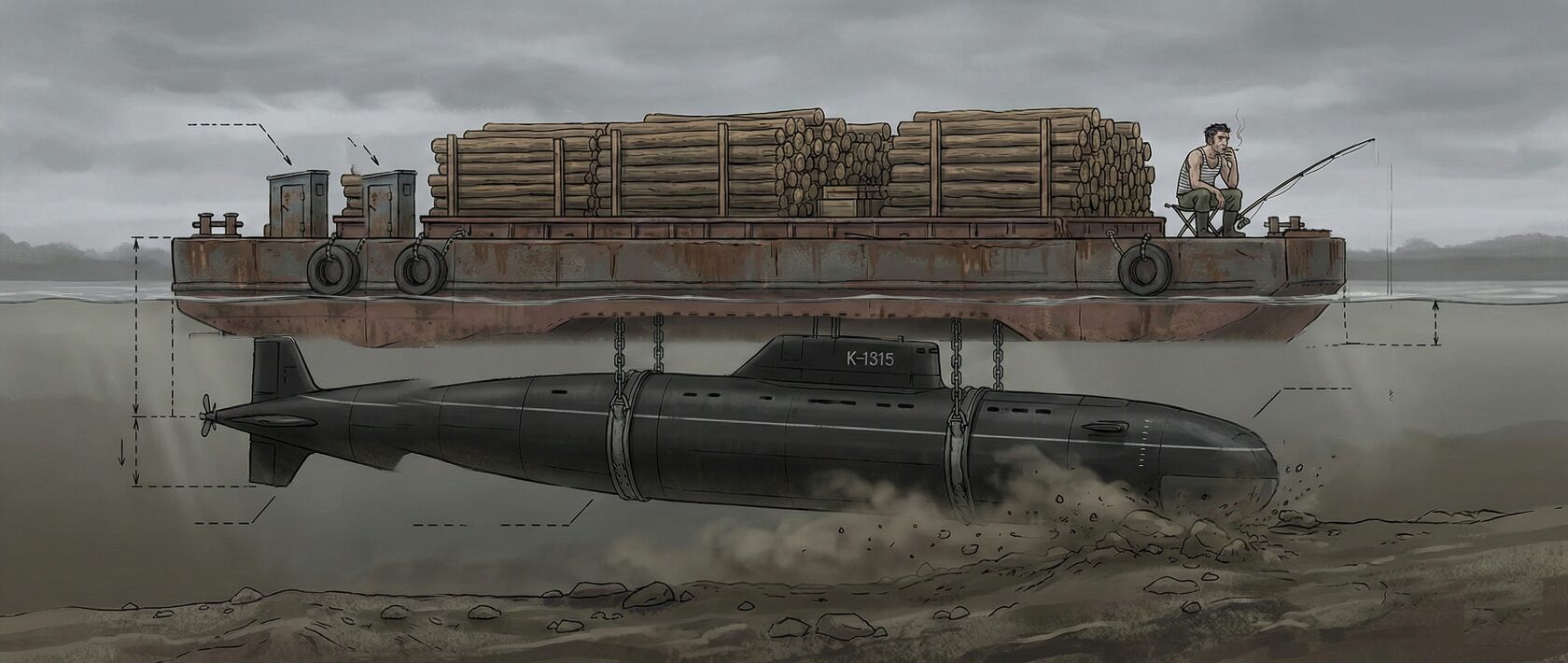
The operation was codenamed "Amur Waltz." Specially for the job—ostensibly to export timber to Japan—they built a monstrously oversized flat-bottomed barge. A timber-hauling raft-carrier. From the outside, just an ordinary tub, only enormous. But that tub had a secret. Its bottom wasn’t flat; it was concave, hollowed inward like an upturned spoon. That created a cavity, a recess—a secret pocket hidden from both human and satellite eyes.
They partially submerged the Ivasi right inside the shipyard backwater at night, in a thick fog. Carefully, with jewelers' precision, down to the millimeter, they eased her underneath the hull of that timber barge. And secured her. Not rigidly, which would have torn the hull apart in a roll, but on special flexible shock-absorbing couplings. She sat there like a baby kangaroo in a pouch. Or a mobster’s piece up a coat sleeve. .. (full chapter in the bool)
Naval Glossary
Declassified glossary of Northern Fleet slang.
Declassified glossary of Northern Fleet slang.I&C - Instrumentation and Control. The shop that officially fixed oscilloscopes and unofficially hid the secret design bureau Nefrit.Kanadka - Fleece-lined Soviet Navy Arctic deck watch coat. Still smelling of the quartermaster's warehouse when new.Shilo - Sailors' name for nearly pure technical alcohol, 95 to 96 percent, 192-proof. Called the soul of the taiga. Used for disinfection, courage, and, according to the crew, decoding signals. Industrial solvents are poisonous. The drinking scenes are satire, not advice.Ivasi / K-1313 - A tiny Far Eastern Pacific sardine, and the name of the unchartable titanium midget submarine at the center of the book. Built across three time zones, clad in melted-down Thai orthopedic pillows.Surstromming - NATO codename for K-1313. A nightmare, with a fishy accent.Nefrit - Ultra-secret Design Sub-Bureau hidden behind a cheap plastic sign reading I&C Maintenance Shop in the Rubin Bureau. Staff: six people. Budget: unlimited, booked as janitorial consumables.Zeus - Planetary 82-Hertz transmitter. Two sixty-kilometer electrodes driven into Kola granite pump a pulse through the planet's core. Lights flicker, worms crawl toward Norway, moose shed antlers out of season.Amur Waltz / Mama-Barge - Operation to smuggle K-1313 down the Amur River hidden under a concave timber barge, like a baby kangaroo in a pouch.
Want to Stay Aboard for the Patrol?
K-1313 has just slipped out of the Amur River into the Strait of Tartary. Twenty-four chapters, a sunken Norwegian seiner, and an NSA bunker await.
If you are a literary agent, publisher, or acquisitions editor, you may request the complete 60,000-word manuscript and one-page synopsis directly on the Agents page. If you are a reader, join the dispatch list to be notified when the English edition is published.
No newsletter. No spam.
Direct contact: author@matrostuzov.com.
Follow the Author
Updates on the English edition and Soviet submarine folklore.
Follow Alexey Tuzov on Facebook for news on the English edition.
Follow on FacebookPress inquiries: author@matrostuzov.com. No newsletter. No spam.
